THE ADELLION FORGE
High-Fidelity Art Pipeline
Overview
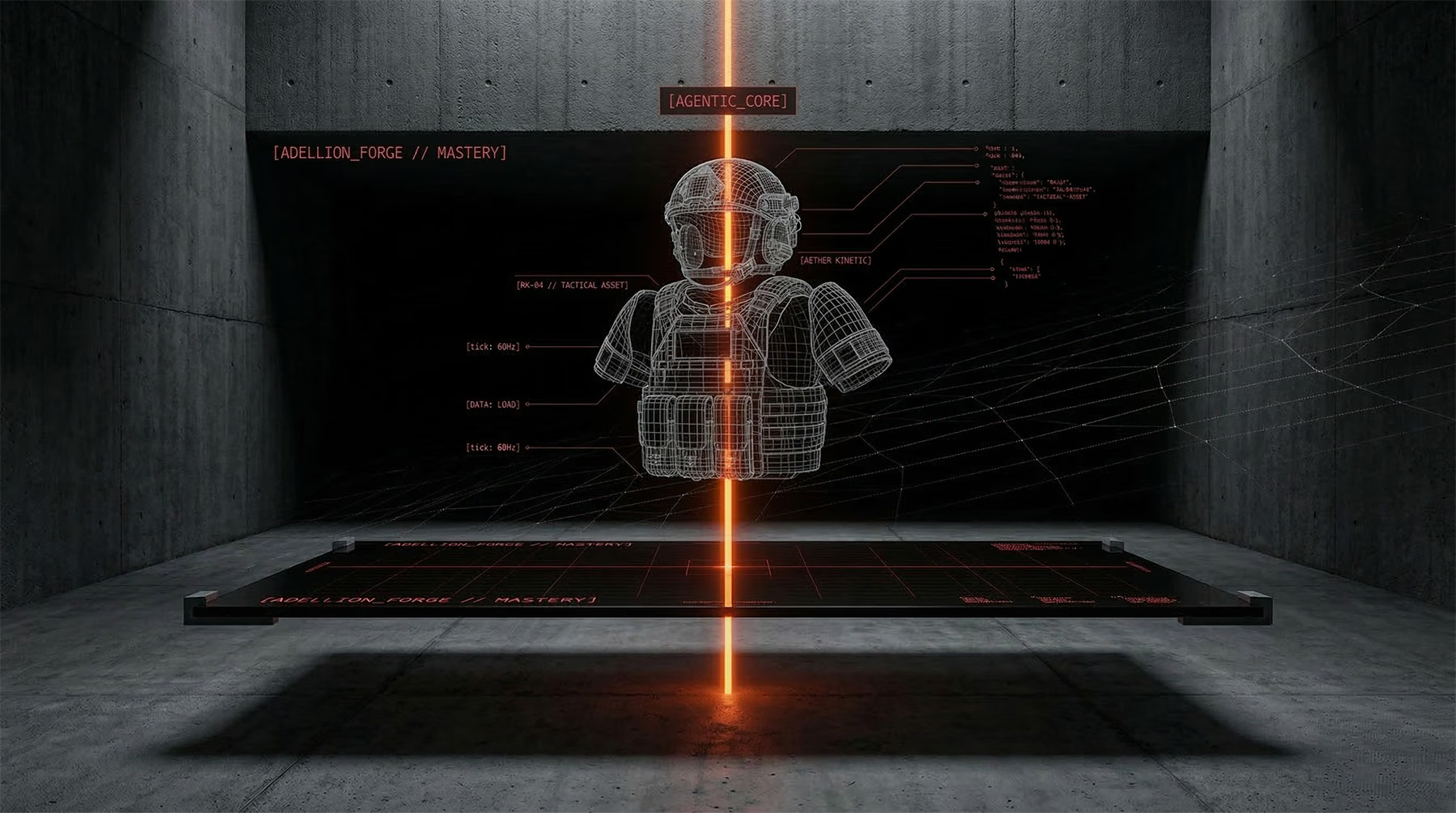
The Adellion Forge is a proprietary development environment and asset pipeline purpose-built for producing AAA-quality experiences on the Roblox platform. It exists because Roblox's default tooling, while improving rapidly, still leaves a significant gap between what the engine can technically render and what most developers actually ship. The Forge closes that gap through standardized, automated workflows built on the SLIM (Simplified Lightweight Immersive Media) framework.
Every component of the Forge is designed around a single principle: visual fidelity should not cost performance. The pipeline produces assets and code that look like they belong in a dedicated game engine while running at stable frame rates on mobile hardware. This is not a post-processing trick. It is a systems-level approach to how geometry, textures, animation, lighting, and scripting interact under real-world resource constraints.
Vertex Animation Textures
Traditional skeletal animation on Roblox consumes CPU budget for every animated instance. At 10 animated characters, this is manageable. At 100, it becomes a bottleneck. At 300+, it is impossible. Vertex Animation Textures (VAT) solve this by baking animation data into texture maps that the GPU reads directly during rendering, bypassing the CPU skeleton pipeline entirely.
How VAT Works
The Forge's VAT pipeline exports animations from Blender or Maya as position and normal maps encoded in RGBA texture channels. Each row of the texture represents a single frame of animation; each pixel encodes the displaced vertex position. At runtime, a custom shader samples the appropriate row based on elapsed time, displacing vertices on the GPU with zero skeletal CPU overhead.
- Supported object count: 100–500+ simultaneously animated objects per scene
- CPU cost per instance: effectively zero (GPU texture sampling only)
- Animation types: rigid body, soft body, fluid simulation, cloth, mechanical
- Texture resolution: typically 512×512 per animation set (configurable)
- Blending: multi-animation blending via shader interpolation between texture rows
VAT is not a workaround. It is the correct way to animate large numbers of objects on a platform where CPU budget is the primary constraint.
PBR Surface Calibration
Roblox's Future is Bright lighting engine supports physically-based rendering, but the relationship between authored PBR maps and final on-screen appearance varies significantly across device tiers and lighting conditions. The Forge includes a calibration system that standardizes PBR authoring and automatically adjusts material parameters for consistent visual quality across the device spectrum.
The Calibration Process
Artists author materials against a reference lighting scene that represents the target game's median lighting conditions. The calibration tool then generates device-tier variants:
- Tier 1 (high-end PC): full PBR with 4K textures, parallax occlusion, subsurface scattering approximation
- Tier 2 (mid-range PC/tablet): standard PBR with 2K textures, simplified roughness
- Tier 3 (mobile): reduced PBR with 1K textures, baked ambient occlusion, simplified specular
The system ensures that a rusted metal surface reads as "rusted metal" on every device, even when the rendering fidelity differs. Color relationships, value hierarchies, and material readability are preserved across tiers.
Automated LOD Streaming
The Forge generates 5 tiers of Level of Detail (LOD) for every mesh asset through an automated CI/CD pipeline. When an artist pushes a final mesh to the asset repository, the pipeline automatically generates LOD1 through LOD4 using progressive mesh decimation with topology-aware edge collapse, preserving silhouette integrity at each reduction level.
Performance Impact
- LOD0 (full detail): used within 20 meters of camera
- LOD1 (75% triangles): 20–50 meters
- LOD2 (40% triangles): 50–100 meters
- LOD3 (15% triangles): 100–200 meters
- LOD4 (billboard/impostor): 200+ meters
Combined with Roblox's Instance Streaming, the LOD system achieves 70–90% draw call reduction on mobile devices compared to shipping full-detail meshes at all distances. The system integrates with the Forge's PBR pipeline—each LOD tier automatically receives the appropriate material variant.
Mastery Scripts Library
The Forge includes a battle-tested library of Parallel Luau optimization patterns for common game systems. These are not black-box modules—they are documented, profiled, and designed to be extended by game-specific code.
Key Patterns
- SharedTable synchronization: lock-free data sharing between worker threads for physics, AI, and player state, enabling massive entity sync without serialization overhead
- Spatial partitioning: octree-based culling that runs on a dedicated worker thread, feeding visibility results to rendering and network replication systems
- Event batching: high-frequency game events (damage, movement, state changes) are batched per-frame and dispatched in bulk, reducing per-event overhead by 85%
- Memory pooling: pre-allocated object pools for frequently created/destroyed entities (projectiles, particles, UI elements), eliminating garbage collection spikes
The library maintains a 60 Hz server tick rate with 120 concurrent players as its baseline performance target. All patterns are profiled against this target in CI, and regressions block deployment.
Performance Benchmarks
The following benchmarks represent a stress-test scene running the full Forge stack: 200 VAT-animated objects, 120 players with full combat systems active, dynamic lighting with 8 shadow-casting sources, and LOD streaming across a 2000-stud environment.
- Mid-tier PC (GTX 1660, Ryzen 5 3600): 58–62 FPS average, 48 FPS 1% low
- High-end mobile (iPad Pro M2): 42–48 FPS average
- Mid-range mobile (Galaxy S21): 30–35 FPS average with LOD3+ aggressive culling
- Server frame budget: 14.2ms average (target: 16.67ms for 60 Hz)
- Memory footprint: 1.8 GB client, 2.4 GB server (120 players)
Roblox 2026 Integration
The Forge is designed to align with Roblox's publicly announced 2026 platform roadmap. Current integration points include:
- Jumpstart Program: Forge-produced assets meet the quality bar for Roblox's featured placement program, with automated compliance checking built into the CI pipeline
- 4K texture support: the PBR calibration system is forward-compatible with 4K source textures, ready to deploy when Roblox lifts current texture resolution limits
- Instance Streaming v2: LOD tier transitions are synchronized with Roblox's Instance Streaming system for seamless asset loading without visible pop-in
- Cloud OAuth: the Forge's deployment and telemetry systems authenticate via Roblox Cloud OAuth, enabling automated publishing and live analytics dashboards