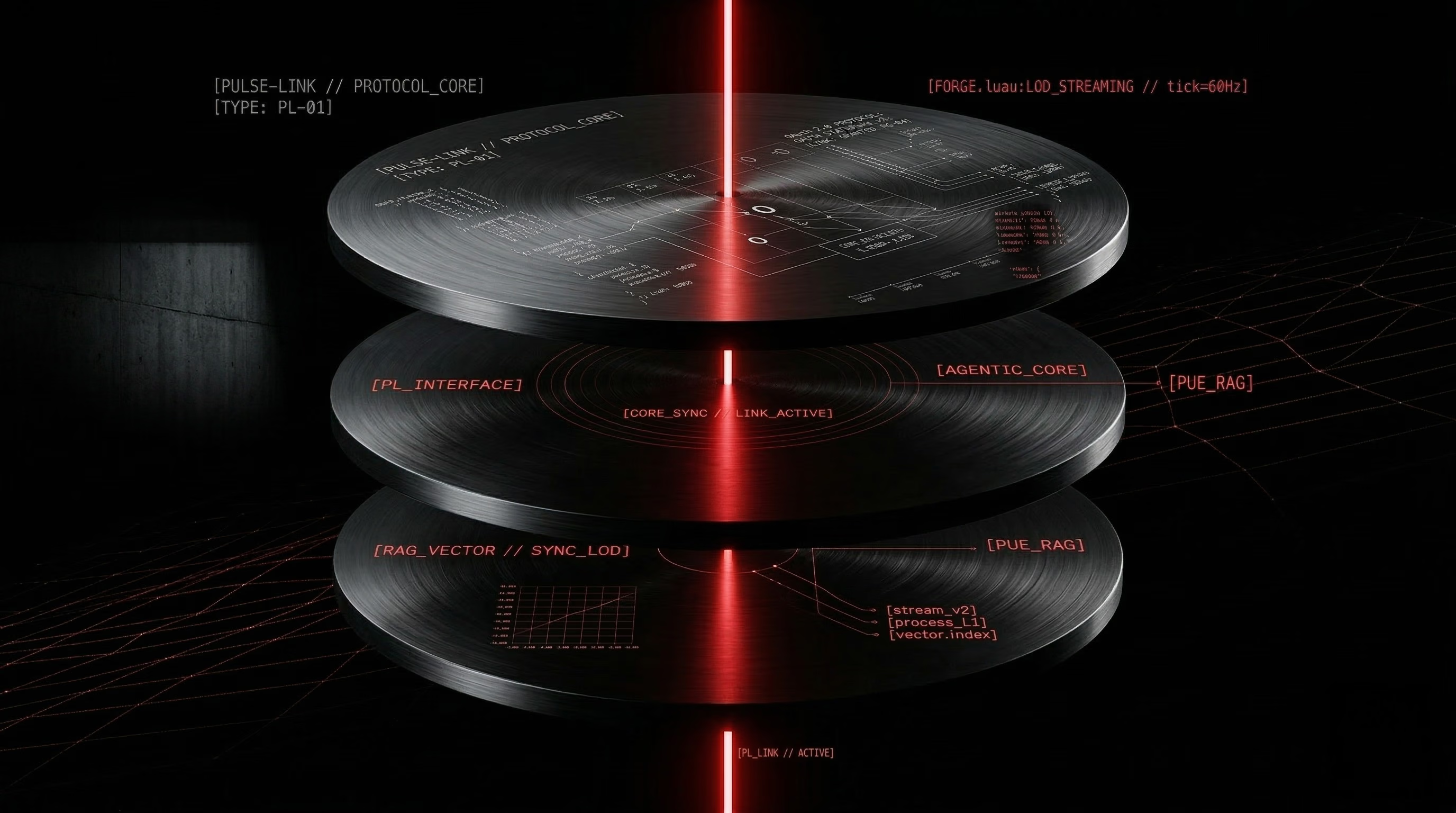
PULSE-LINK
Unified Identity Protocol
Overview
Every platform in the Simplified Media Network generates valuable signal about its users. A reader on Adellion who consistently engages with deep technical content about game design is demonstrating expertise. A Nexus user who accurately acts on meta predictions is demonstrating competitive intelligence. An Auntie Atom player who completes high-difficulty encounters is demonstrating skill. But without a connective layer, these signals remain siloed—isolated data points that cannot inform each other or compound into something greater.
Pulse-Link is that connective layer. It provides a Persistent Universal Identity (PUID) that travels with the user across every SMN touchpoint, aggregating engagement signals into a portable, verifiable expertise profile. The PUID is not a login system—it is an identity protocol that makes expertise legible and portable.
A reader who masters a topic on Adellion should be recognized for that mastery when they enter a game built on that topic. Pulse-Link makes that recognition automatic, private, and consent-driven.
The Expertise Score Algorithm
At the core of Pulse-Link is the Expertise Score (ES)—a composite, decay-aware metric that quantifies a user's demonstrated knowledge and skill within specific domains. The ES is not a simple point accumulation. It is a living score that reflects both the depth of engagement and its recency.
Signal Weights
Different engagement types contribute different weights to the ES, calibrated to reflect the depth of understanding they demonstrate:
- Deep reads (completion >80%, dwell time >4 min): weight 8–10
- Quiz/assessment completions: weight 5–7 (scaled by accuracy)
- In-game achievements: weight 7–12 (scaled by difficulty tier)
- Community contributions (verified answers, guides): weight 6–8
- Nexus prediction accuracy: weight 9–11 (scaled by prediction difficulty)
- Casual engagement (page views, short reads): weight 1–3
Temporal Decay
All signals are subject to a 90-day half-life decay function. A deep read completed today contributes its full weight. The same read's contribution halves every 90 days. This ensures that the ES reflects current expertise rather than historical accumulation—a user who was an expert six months ago but has stopped engaging will see their score naturally decline, accurately reflecting that their knowledge may be outdated.
The decay function uses an exponential model: ES_contribution = weight * 0.5^(days_elapsed / 90). Domain-specific scores are computed independently, so expertise in one area does not inflate scores in another.
Secure JWT Integration
Pulse-Link authenticates via OAuth 2.0 + OpenID Connect (OIDC), issuing signed JWTs that carry the user's PUID and current ES values as claims. Partner platforms validate tokens locally without calling back to Pulse-Link servers, enabling offline-capable identity verification.
Roblox Cloud OAuth Compatibility
The protocol is designed for direct compatibility with Roblox Cloud OAuth, enabling Roblox experiences to authenticate Pulse-Link identities and inject expertise-based rewards without custom authentication flows. When a player joins an SMN game on Roblox, the game server exchanges the player's Roblox identity for a Pulse-Link JWT, gaining access to their cross-platform expertise profile.
This enables dynamic reward injection: a player who has demonstrated deep expertise on Adellion's game design content might receive access to advanced crafting recipes or exclusive cosmetic tiers when they enter a related game. The rewards are not arbitrary—they are earned through demonstrated knowledge.
Event-Driven Sync via Kafka
Profile synchronization across the SMN operates on an event-driven architecture powered by Apache Kafka. Every engagement event—a read completion, a quiz score, an in-game achievement—is published to Kafka topics partitioned by PUID. Consumers update the expertise model in near-real-time.
Performance Characteristics
- Event throughput: 15,000+ events per second sustained
- Profile reflection latency (p95): <500ms global—an achievement earned in a Roblox game is reflected in the user's Adellion profile within half a second
- Partition strategy: PUID-based partitioning ensures ordered processing per user while enabling horizontal scaling across consumers
- Dead letter queue: failed events are captured with full context for replay, ensuring zero data loss
Privacy & Compliance
Pulse-Link is built on a consent-first model. No cross-platform data flows without explicit user authorization. Users control exactly which platforms can read their expertise profile and which engagement signals contribute to their ES.
Regulatory Framework
- GDPR compliance: full data portability (export), right to erasure (delete PUID and all associated data), granular consent management
- CCPA compliance: "Do Not Sell" support, transparent data collection disclosure, opt-out mechanisms
- Data minimization: Pulse-Link stores the minimum data required to compute the ES. Raw engagement events are processed and discarded—only the computed score contributions and their timestamps are retained
- Age gating: enhanced protections for users under 16, including parental consent flows and restricted cross-platform data sharing
SDK Integration
Pulse-Link provides SDKs for the two primary integration surfaces: Roblox Luau for in-game experiences and JavaScript/TypeScript for web platforms.
Roblox Luau Example
Game servers authenticate via Roblox Cloud OAuth and query the player's expertise profile to determine reward eligibility:
local PulseLink = require(game.ServerScriptService.PulseLink)

game.Players.PlayerAdded:Connect(function(player)
    local profile = PulseLink:GetProfile(player.UserId)
    if profile and profile.expertiseScore >= 75 then
        GrantExpertRewards(player, profile.domains)
    end
end)
Web SDK Example
Editorial platforms embed the Pulse-Link tracker to record engagement signals:
import { PulseLink } from '@simplified/pulse-link'

const pl = new PulseLink({ appId: 'adellion-web' })
pl.trackRead({
  articleId: 'forge-pipeline-deep-dive',
  completionPercent: 92,
  dwellTimeSeconds: 340,
  domain: 'game-dev:art-pipeline'
})
Roadmap
- Q2 2026: Roblox OAuth integration + Luau SDK public release—enabling any Roblox developer to integrate Pulse-Link identity into their experiences
- Q3 2026: Mobile push notification system for real-time expertise milestones and cross-platform reward availability alerts
- Q4 2026: Partner portal for third-party developers to define custom reward mappings against Pulse-Link expertise domains, opening the protocol beyond SMN first-party titles